

Still Thirsty
What a lonely woman at a well discovered about the one thirst nothing in this world can quench

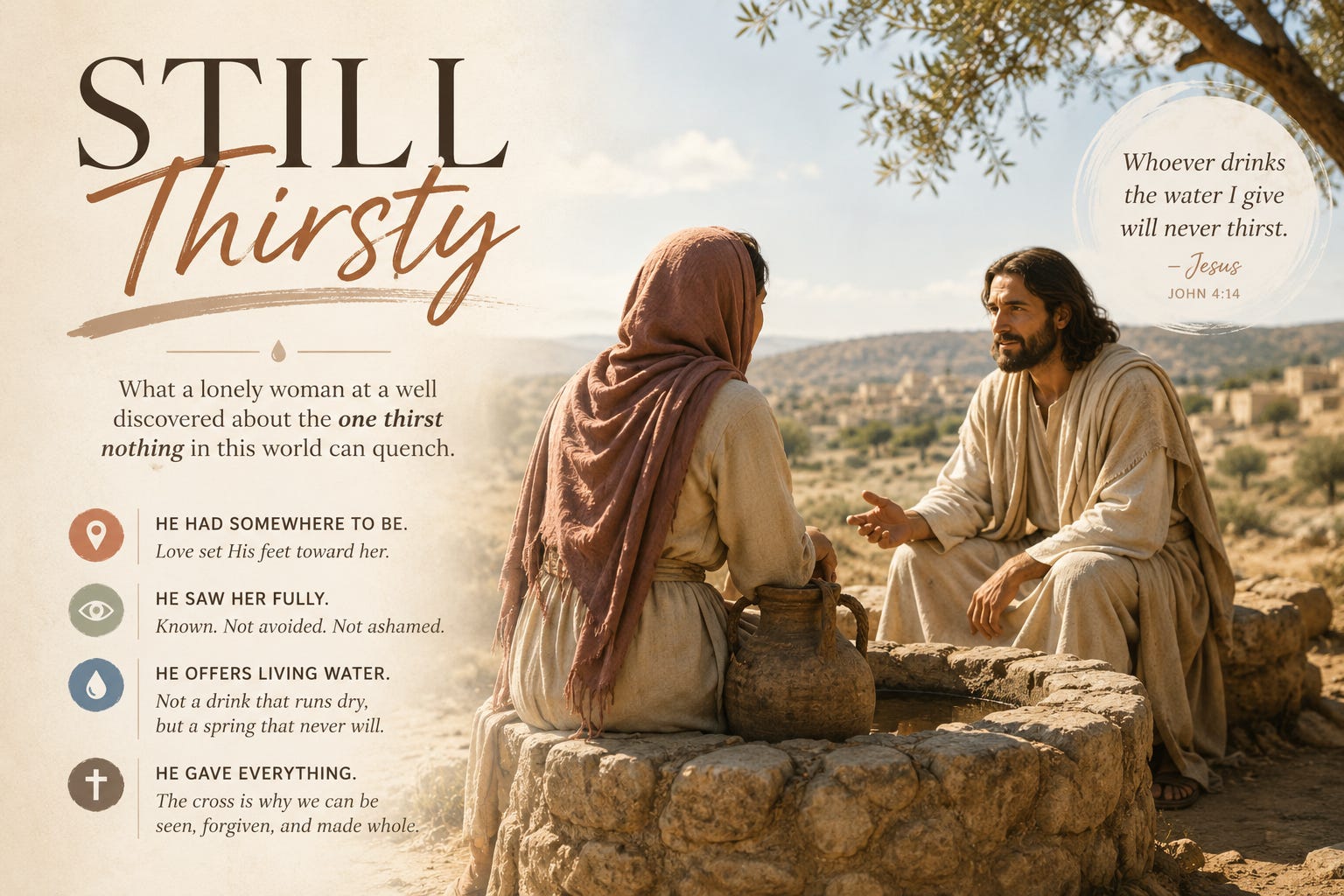
The sun sits straight overhead, and the village is empty. No one carries water at noon. The women of the town come in the cool of the morning or in the gold of the evening, when the path to the well is crowded with voices and laughter and the small daily news of life. But there is one woman who waits for the heat. She times her walk for the hour when the path is empty, because an empty path means no whispers, no sideways glances, no faces reminding her of what the town has already decided about her. She would rather carry her heavy jar under a punishing sun than carry the weight of all those eyes. So she comes at noon, alone, the way she has learned to do everything. And at noon, she finds a stranger sitting at the well, waiting for her, as though He had come all that way for no other reason than to meet her there.
He Had Somewhere to Be
There is a small phrase in this story that is easy to read straight past, and yet it carries the whole weight of the gospel inside it. John tells us that Jesus left Judea, and then he writes this:
“Now he had to go through Samaria. So he came to a town in Samaria called Sychar, near the plot of ground Jacob had given to his son Joseph. Jacob’s well was there, and Jesus, tired as he was from the journey, sat down by the well. It was about noon.” (John 4:4-6, NIV)
He had to go through Samaria. Now, that was not true in the way we might first hear it, because no respectable Jewish traveler in that day had to set foot in Samaria at all. The Jews and the Samaritans despised one another, and the well-worn custom was to cross the Jordan and go the long way around, adding miles to the trip simply to avoid this despised stretch of ground. So when Scripture says Jesus had to go through Samaria, it is not telling us about geography. It is telling us about His heart. There was an appointment to keep. There was one rejected woman, on one ordinary day, at one ordinary well, and the Son of God arranged the whole of His journey so that He would be sitting there, tired and thirsty, at the exact hour she came to draw water. Jesus is God and had arranged this meeting from eternity, and Jesus is man, tired and thirsty.
This is who Jesus is, and it is the very thing He later said about Himself, that He came to seek and to save the lost. The same love that set His feet toward Samaria to find one woman is the same love that would later set His face toward Jerusalem to find all of us, and He went to the cross because He chose it out of love. He laid down His life of His own accord, no one taking it from Him, and He did it gladly, for the joy of bringing home the very people the world had given up on.
The One Everybody Avoided, and the One Who Came Looking
As the conversation unfolds, Jesus says something that should have ended the encounter on the spot.
“He told her, ‘Go, call your husband and come back.’ ‘I have no husband,’ she replied. Jesus said to her, ‘You are right when you say you have no husband. The fact is, you have had five husbands, and the man you now have is not your husband. What you have just said is quite true.’” (John 4:16-18, NIV)
Five husbands, and now a sixth man she had not even married. Here was a woman the religious people of her day would have crossed the road to avoid, a woman whose story had become the town’s gossip, a woman who had built her whole life around dodging the people who whispered about her. And Jesus, knowing every line of that story before she said a word, did not flinch and did not step back. He stepped toward her. He named her life, not to shame her, but so that she would know she had finally been fully seen and fully known, and was not despised after all.
That is the wonder of it, that being completely known and still completely welcomed is the very thing the human heart aches for and rarely believes is possible. And it is possible only because of the cross, where Jesus was numbered with the transgressors, treated as though He were the outcast, bearing the real guilt of real sinners so that He could look the guilty in the eye and call them home. He does not love us because He has not noticed our sin. He loves us having seen all of it, having carried all of it, having paid for all of it.
Two Kinds of Water
Then Jesus turns the whole conversation toward the deepest thing, and He does it with the water sitting right there between them.
“Jesus replied, ‘Anyone who drinks this water will soon become thirsty again. But those who drink the water I give will never be thirsty again. It becomes a fresh, bubbling spring within them, giving them eternal life.’” (John 4:13-14, NLT)
Anyone who drinks this water will be thirsty again. Notice He says this water, the water in the well, the water she had to keep coming back for, day after day after day, because no single trip ever filled her for good. And that well water was a picture of her whole life. Five husbands, then a sixth man, each one a bucket lowered down into the same dry well, each one promising at last to satisfy the thirst for love, and each one leaving her standing at noon, jar in hand, needing to come back again.
We must be honest enough to see ourselves standing at that same well, because all of us are drinking this water. For one person it is relationships, the next face that will finally make us feel chosen. For another it is alcohol, or food, or pornography, or the endless scroll, or the applause of a crowd, or money in the bank, or even religion itself, the quiet pride of keeping the law well enough to feel clean. The list is long, but the pattern never changes, because every one of these is a bucket dropped into a well that always runs dry. The old song put words to what every heart already knows, “I can’t get no satisfaction, though I try, and I try, and I try.” We cannot get it from these wells, and we never will, for the simple reason that they were never the spring.
Why His Spring Never Runs Dry
So where did the living water come from, and why does it never run out? It came at terrible cost. Our thirst is not really for water or wine or another body in the bed, or another all you can eat buffet, it is a thirst that wells up from within us, out of our sin and our separation from God. And on the cross, Jesus took that sin, the very thing that makes us thirsty, and He drank it down to the dregs in our place. Hanging there, having borne it all, He cried out:
“Later, knowing that everything had now been finished, and so that Scripture would be fulfilled, Jesus said, ‘I am thirsty.’” (John 19:28, NIV)
He was thirsty in body, yes, His lips cracked and dry on that wood. But He was also drinking down our thirst, taking into Himself the dryness of every parched and sinful heart, so that He could say a moment later, “It is finished.” The debt was paid. The guilt was carried away. And then, on the third day, the One who died went down into the grave and came up out of it alive, and the tomb could no more hold Him than a well can hold the sea. That is the gospel, that Christ died for our sins and rose again, and it is from that empty tomb that the living water flows, a spring of resurrection life welling up in everyone who comes to Him.
This is why the woman at the well left her water jar behind. She had come for well water and found a spring, and the spring made the bucket unnecessary. She ran back to the very town she had spent years avoiding and told them all to come and see the man who told her everything she ever did.
If you are still walking out to the well at noon, hoping the next image, meal, drink, etc. will finally satisfy you, hear the offer Jesus is still making. You do not have to keep coming back. Come and drink from Him, in His Word, at His cross, in the forgiveness He freely gives, in the power of His Spirit poured out in you, and you will find that the thirst you have carried your whole life finally, at last, begins to be quenched from the inside out.
Beautifully written. John 4 is incredibly powerful and you certainly captured its glory.