
When Strength Fails
What God Does When You Have Nothing Left

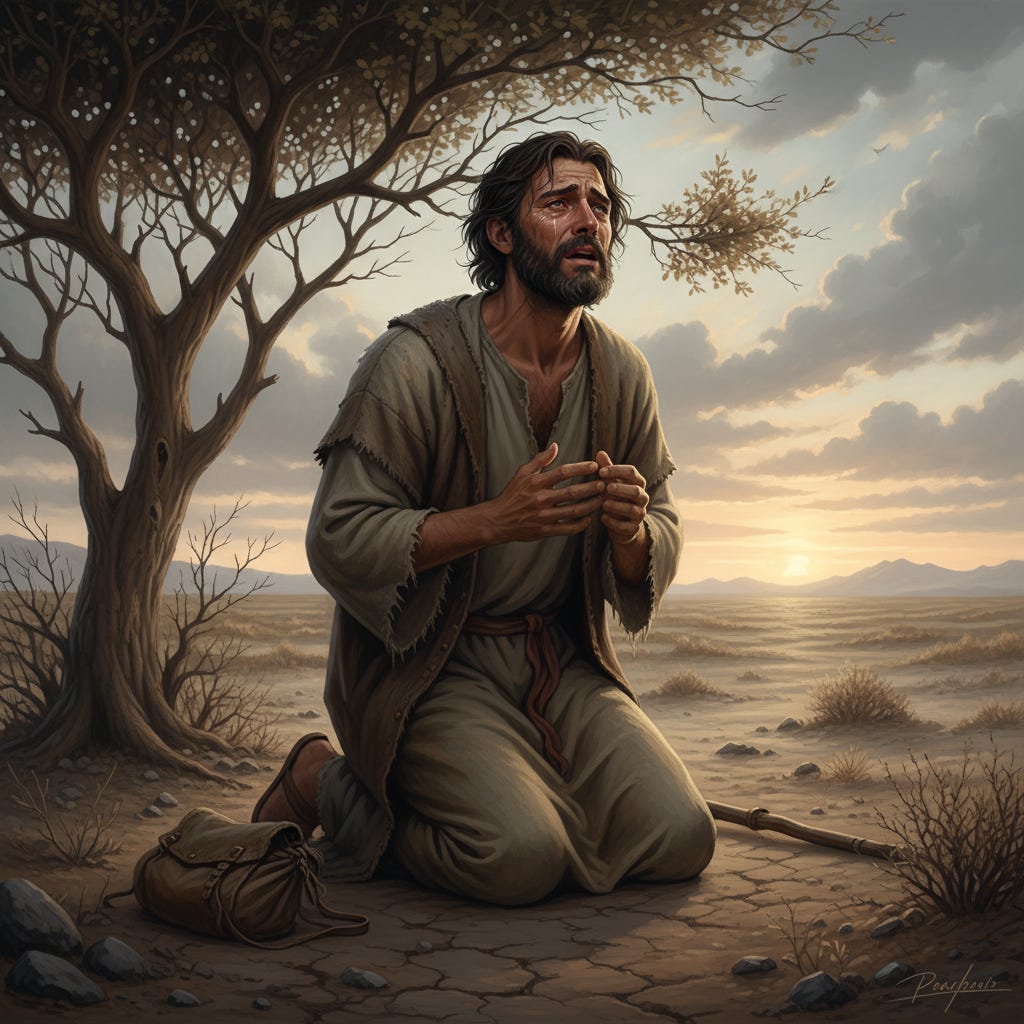
Have you ever felt like you’ve given everything you have, and it still wasn’t enough? Like you’ve run a marathon only to discover there’s another mountain to climb? That’s where we find Elijah in 1 Kings 19—not on a mountaintop of victory, but collapsed under a broom tree, asking God to let him die.
This might surprise you. Just one chapter earlier, Elijah called down fire from heaven on Mount Carmel. He defeated 450 prophets of Baal in the most spectacular showdown in Israel’s history. Rain fell after three years of drought. It was the Super Bowl, the championship game, the apex of his ministry—and Elijah won.
But now? Now he’s running for his life from Queen Jezebel’s death threat, and he’s completely undone.
When Victory Doesn’t Feel Like Victory
Here’s what we need to understand: Elijah’s breakdown didn’t happen because he failed. It happened because he succeeded—and then realized that even his greatest victory didn’t change everything. Jezebel was still in power. The nation hadn’t truly turned back to God. And Elijah was utterly spent.
It’s like a student who works tirelessly to graduate, only to face an uncertain job market. Or a parent who finally gets their struggling child stabilized, only to have another crisis emerge. Or someone who overcomes one health challenge, only to receive another difficult diagnosis. You did everything right, gave everything you had, and somehow... it wasn’t the ending you expected.
Listen to Elijah’s prayer: “I have had enough, LORD. Take my life” (1 Kings 19:4, NIV). This is brutal honesty. No spiritual platitudes. No fake smile. Just a servant of God at the absolute end of himself.
God’s Surprising Response
Now, if I were writing this story, I’d have God give Elijah a motivational speech. “Buck up, prophet! Remember Mount Carmel? You’ve got this!”
But that’s not what happens.
Instead, “an angel touched him and said, ‘Get up and eat’” (1 Kings 19:5, NIV). And what did the angel provide? Bread and water. Not a miraculous vision. Not a theological lecture. Not even a rebuke for his despair. Just... breakfast.
Then the angel lets him sleep. And then—here’s the tender mercy—the angel comes again with more food: “Get up and eat, for the journey is too much for you” (1 Kings 19:7, NIV).
Read that again. God acknowledges that the journey is too much. He doesn’t minimize Elijah’s exhaustion or shame him for his weakness. He validates it. “You’re right, Elijah. This IS too much for you. Here, have a muffin and a nap.”
Think about this like a parent with a small child who’s trying to carry a suitcase that’s bigger than they are. The parent doesn’t scold the child for struggling. The parent picks up the suitcase and carries it themselves. That’s what God does here.
The Journey to Horeb
Strengthened by that food, Elijah travels forty days and forty nights to Horeb, the mountain of God. He finds a cave and spends the night. And then God asks him a simple question: “What are you doing here, Elijah?” (1 Kings 19:9, NIV).
Elijah pours out his heart: “I have been very zealous for the LORD God Almighty. The Israelites have rejected your covenant, torn down your altars, and put your prophets to death with the sword. I am the only one left, and now they are trying to kill me too” (1 Kings 19:10, NIV).
Can you hear the weariness? The isolation? “I am the only one left.” When you’re exhausted, everything feels heavier, and you feel utterly alone. Even when you’re not.
The Wind, Earthquake, and Fire
Then comes one of the most dramatic moments in Scripture. God tells Elijah to stand on the mountain because “the LORD is about to pass by” (1 Kings 19:11, NIV).
A powerful wind tears the mountains apart and shatters rocks—but the LORD is not in the wind. Then an earthquake—but the LORD is not in the earthquake. Then fire—but the LORD is not in the fire.
And then? “A gentle whisper” (1 Kings 19:12, NIV). Some translations say “a still small voice.”
Here’s what God is teaching Elijah (and us): When you’re depleted and worn down, you don’t need more spectacular displays of power. You’ve already seen the fire from heaven. What you need is the intimate, quiet presence of God drawing near.
It’s like when you’re sick and don’t need someone to perform for you or impress you—you just need someone to sit beside your bed and hold your hand. God meets Elijah not in the pyrotechnics, but in the whisper.
God Recalibrates Everything
In that whisper, God gives Elijah three assignments: anoint new kings, anoint a new prophet, and then this bombshell: “Yet I reserve seven thousand in Israel—all whose knees have not bowed down to Baal” (1 Kings 19:18, NIV).
Seven thousand. Elijah thought he was alone. He thought he was the only one left. But God says, “You’re not alone, and you never were. I have thousands of faithful people you don’t even know about.”
When you’re exhausted, your perspective shrinks. You can only see your own struggle, your own failure, your own isolation. But God sees the whole picture. He’s working in ways you cannot see, through people you’ve never met, accomplishing purposes beyond your imagination.
The Ultimate Rest
But here’s where we must land, because this story—as beautiful as it is—is still incomplete without the gospel.
Elijah needed bread from heaven to make his journey. But there is One who said, “I am the bread of life. Whoever comes to me will never go hungry” (John 6:35, NIV).
Elijah heard God’s gentle whisper on the mountain. But there is One who says, “Come to me, all you who are weary and burdened, and I will give you rest” (Matthew 11:28, NIV).
Elijah collapsed under the broom tree, wanting to die. But there is One who actually died—not because He was defeated, but so that you could live. Jesus Christ went to a different tree, a cross, and there He didn’t run from death—He embraced it. He took on every sin, every failure, every burden you could ever carry. And then He rose from the dead, victorious over everything that could ever defeat you.
Do you see it? Elijah’s story points us to something greater. When you have nothing left, Jesus has already given everything. When your strength fails completely, His strength is already complete. When you feel utterly alone, He has promised, “I am with you always, to the very end of the age” (Matthew 28:20, NIV).
The resurrection means that even when you’re buried under the weight of exhaustion, depression, or despair—even when you’re as good as dead—God specializes in bringing life from death. That’s His signature move. That’s the gospel.
So What Do We Do?
When your strength fails, do what Elijah did: Be honest with God about your exhaustion. Accept His provision—the rest, the nourishment, the time you need to recover. Listen for His gentle whisper rather than demanding another spectacular sign. Trust that He’s working in ways you cannot see.
And ultimately, run to Jesus. Not to perform better or try harder, but to find the rest that He alone can give. His death means you don’t have to earn God’s approval when you’re strong or fear losing it when you’re weak. His resurrection means that there is always, always hope—even when you’re under the broom tree with nothing left.
You may be at the end of your strength. But you are not at the end of His.
This reflection is part of the “When Faith Feels Fragile” series — honest letters to weary hearts, anchored in Scripture and hope.
Praise God. His strength is amazing. Without it, it is impossible. Thank Jesus for his strength and not my own. Thank you for this blessing it was truly encouraging. God bless and have a wonderful day.
Thank you. I have saved this to look at on the days I will need it. I tell God, very honestly, how I feel & what my needs are. He knows anyway. I know he will provide what is best, in His way & in His perfect timing.
It stikes me as interesting how people love to say that God won't give you more than you can handle, but He often does as illustrated here. I am in this constant state at this time due to my husband. First, he had stage 4 brain cancer. He had been extremely healthy & strong before this and was full of life & dreams. Then in early August, he died. I was in another room, maybe 5' away, not at his bedside, as I had wanted to be. It is now my kids & me left to move forward without him.
I had many struggles in that time of caregiving and there has been a constant seemingly unending barrage since and many times, I've said similar things. But, God keeps providing in so many ways, large and small. It is humbling and amazing. He is constantly busy doing things I don't even know.
Thank you for your encouragement today. It was a perfect message.